Inclusive and Bankable Climate Solutions for Communities in Cambodia
Co-developing inclusive, bankable climate adaptation solutions through a Multi-Stakeholder Action Lab.
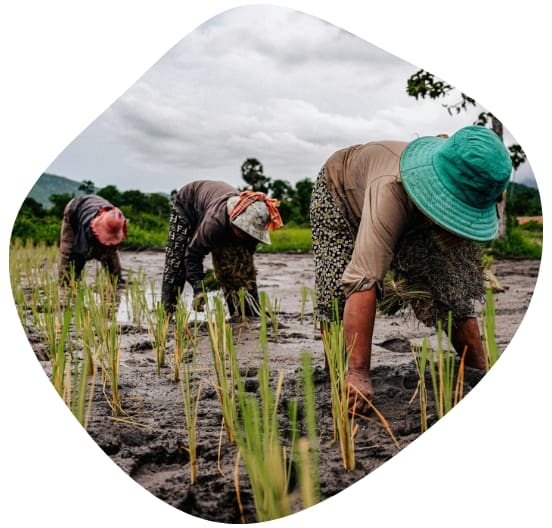
Climate Ready Village supports a community-driven approach to developing climate adaptation solutions. The process begins with rural communities and rights-holder groups identifying the climate challenges that affect their lives and livelihoods. It then brings in the right partners to help respond to those priorities through a participatory co-design process.
Using a Multi-Stakeholder Action Lab (MAL) based on the Living Labs approach, the program co-designs, tests, and supports the adoption of inclusive, bankable adaptation solutions. These solutions are designed so that communities can access them, financial actors can help deploy them, and partners can scale them over time.
Climate Ready Village is a part of the regional Inclusive Climate Finance for Vulnerable Communities in the Asia-Pacific (ICCAP) project.
Interested in contributing to the Climate Ready Village program? Connect with us today!
About Climate Ready Village
Cambodia is highly vulnerable to climate risks, which directly affect rural livelihoods, agriculture, food security, access to water, and household incomes. To address this issue, Climate Ready Village, a part of the regional Inclusive Climate Finance for Vulnerable Communities in the Asia-Pacific (ICCAP) project, implemented by Impact Hub Phnom Penh in Cambodia in collaboration with the Stockholm Environment Institute (SEI). This program focuses on establishing and hosting a Multi-Stakeholder Action Lab at the community scale.
Through a community-based, participatory, and inclusive process, the program works with partner smallholders and rightsholders to:
- Identify and co-define the climate hazards and multidimensional impacts they face;
- Collaboratively prioritize needs;
- Co-design possible solution pathways.
Our approach
Phase 1: Target Area Selection and Setup — 2026
Climate Ready Village is currently identifying the best-fit pilot community based on climate vulnerability, livelihood impact, socio-economic marginalization, operational feasibility, local authority support, and the community’s willingness and capacity to participate responsibly and meaningfully.
Phase 2: Climate Vulnerability and Needs Assessment — 2026
The program will conduct household surveys, focus group discussions, key informant interviews, and consultations to understand intersectional climate risks, coping strategies, access to financial services and livelihood solutions, and community priorities.
Phase 3: Problem Co-Defining and Program Launch — 2026–2027
Communities and key stakeholders will validate findings, prioritize a shared climate adaptation challenge, and officially launch the Climate Ready Village program.
Phase 4: Co-design and Pilot Testing — 2027–2028
Community members, Green Solution Providers, Financial Service Providers, and other stakeholders will co-design and test practical adaptation solutions in real-life settings.
Phase 5: Adoption, Scale-Up, and Learning — 2028–2029
The program will explore financing and scaling pathways, support wider adoption, document learning, and inform future replication or policy uptake.
Who We Hope to Engage
As the Climate Ready Village program develops, we will progressively engage partners who can contribute local knowledge, practical solutions, finance, technical expertise, and long-term support for inclusive climate adaptation.
We hope to connect with:
Community and rightsholder groups
representing women, people with disabilities, Indigenous Peoples, ethnic minorities, smallholder farmers, and other marginalized groups within the selected pilot province (Battambang).
Green Solution Providers
with products, technologies, services, or business models related to climate adaptation, agriculture, water, renewable energy, livelihoods, or resilience, and who are interested in piloting or adapting their solutions in rural community settings and serving bottom-of-the-pyramid markets.
Financial Service Providers
such as MFIs, banks, cooperatives, insurers, investors, and other actors interested in providing inclusive green finance or adaptation finance.
Local authorities and public-sector actors
who are interested in support coordination, local engagement, policy learning, and future adoption.
Researchers and technical experts
in climate, agriculture, water, finance, gender, disability inclusion, Indigenous Peoples, and social inclusion.
Civil society and development partners
with experience in community engagement, climate resilience, livelihoods, financial inclusion, and rights-based development.
All your questions, answered
A Multi-Stakeholder Action Lab, or MAL, is a structured co-creation process based on the living labs approach, where communities and partners work together to understand a problem, design possible solutions, test them, and learn from the results.
For Climate Ready Village, the MAL starts with community realities. It is not a one-time consultation or a ready-made solution brought into a village. It is a multi-year process that moves from understanding real needs to problem prioritization, co-design, pilot testing, adoption, and learning.
The partner community will be engaged through a Target Area Selection process. The Climate Ready Village program will consider climate vulnerability, livelihood impact, socio-economic marginalization, operational feasibility, local authority support, and community willingness to participate.
After the partner community is selected, the program will conduct a Climate Vulnerability and Needs Assessment through household surveys, interviews, focus group discussions, and consultations. Community members and rightsholder groups will not only provide information; they will be active partners in validating findings, sharing priorities, and co-defining the climate adaptation problem that the program will focus on.
The priority problem will therefore be identified through community input and validated with relevant stakeholders. Community participants will be supported throughout the process to ensure responsible, inclusive, and meaningful participation.
In ICCAP, bankability refers to the extent to which the value of a climate adaptation solution can be translated into a realistic financing pathway for a specific actor. This value may be monetary or non-monetary. In some cases, it may come from direct revenue or cost savings. In other cases, it may come from avoided losses, reduced vulnerability, improved resilience, public benefits, or wider social and environmental value.
A bankable adaptation solution should address a real community need, improve adaptive capacity, be practical to implement, be socially inclusive, and show a credible value case for financial actors or partners to test, improve, and support. It does not need to be perfect from the beginning, but it should be sufficiently developed to go through refinement, testing, and validation towards adoption and financing.
Relevant green solutions may include locally appropriate technologies, services, business models, financial products, ecosystem-based measures, infrastructure improvements, or institutional arrangements that help rural communities adapt to climate risks and strengthen resilience. These may relate to climate-resilient agriculture, water management, irrigation, renewable energy, livelihood resilience, post-harvest handling and storage, climate information, disaster preparedness, recovery, or other practical adaptation needs. The final focus will depend on the priority climate adaptation problem co-defined with the partner community.
The project does not assume that all local adaptation solutions can or should be commercially financed. Many will continue to require public or grant-based support. However, the project is open to collaboration with private funders, philanthropies, impact investors, insurers, banks, MFIs, FSPs, and companies that can help de-risk, pilot, aggregate, and scale promising adaptation solutions. Their role is catalytic: to help convert locally-grounded adaptation practices into financeable pathways where appropriate, while ensuring that vulnerable communities are not exposed to unaffordable costs or excessive risk.
Your solution should be developed enough to be tested, adapted, or improved through the MAL process. This could be an existing product, prototype, service, or tested model with some evidence of use or potential. The solution does not need to be final. Green Solution Providers should be open to adapting their solutions based on community feedback, affordability, usability, and real-world testing over an extended period.
Selected Green Solution Providers may receive support to adapt, improve, and test their climate adaptation solutions with the partner community in a real-world setting. This can help providers understand how their solution works in practice, collect direct feedback from community members, and refine the solution based on local needs, affordability, usability, and implementation conditions.
Selected providers may also receive technical guidance, business development support, and opportunities to engage with relevant partners, including local authorities, experts, Financial Service Providers, and other private-sector or development actors. Through the co-design and pilot process, providers will be able to contribute their technical knowledge while learning how their solution can better respond to community priorities and climate adaptation needs.
In return, selected providers should be ready to join co-design workshops, listen to community feedback, adapt their solutions where needed, support pilot testing, and share relevant technical and business information.
Climate Ready Village is currently conducting the Target Area Selection process. After the partner community has been engaged, the program will conduct a Climate Vulnerability and Needs Assessment to define the priority climate adaptation challenge(s). Once the priority problem is clear, the program will launch an open call for Green Solution Providers whose solutions can respond to that challenge.
Financial Service Providers will help explore pathways to make climate adaptation solutions more affordable and accessible for communities. Their role may include sharing financing requirements, assessing solution viability, helping shape suitable financial products, and supporting pathways for adoption and scale. Their involvement helps ensure that solutions are not only needs-responsive, but also realistic to finance and sustain.
Local Government Units and policymakers will help connect the Climate Ready Village process with local planning, coordination, and policy learning. Their role may include supporting local engagement, sharing public-sector priorities, joining problem-validation discussions, and helping to ensure that tested solutions align with local systems and future adoption pathways. Their involvement helps the program generate learning that can inform wider climate adaptation and inclusive finance efforts beyond the partner community.
The project does not assume that all local adaptation solutions can or should be commercially financed. Many will continue to require public or grant-based support. However, the project is open to collaboration with private funders, philanthropies, impact investors, insurers, banks, MFIs, FSPs, and companies that can help de-risk, pilot, aggregate, and scale promising adaptation solutions. Their role is catalytic: to help convert locally-grounded adaptation practices into financeable pathways where appropriate, while ensuring that vulnerable communities are not exposed to unaffordable costs or excessive risk.
Do you have more questions?
If you have further questions, don’t hesitate to reach out to the Program Manager (Chermeng) at chermeng.thang@impacthub.net | Telegram: (+855) 69 676 650

About ICCAP
The Inclusive Climate Finance for Vulnerable Communities in the Asia-Pacific (ICCAP) project is funded by the International Climate Initiative (IKI) and will run from 2024 to 2029. It is designed to enhance economic, social, and environmental resilience in vulnerable regions across Asia and the Pacific by channeling national and international public and private climate adaptation finance flows to vulnerable communities and marginalized groups affected by climate change.
ICCAP is designed to channel national and international public and private climate adaptation finance flows to vulnerable communities and marginalized groups affected by climate change. It supports the development and scaling of green financial products that meet the needs of rural smallholders and climate-vulnerable populations, such as women, Indigenous Peoples, persons with disabilities, and those who are economically and socially excluded. Grounded in a strong commitment to inclusion and equity, ICCAP promotes locally led solutions, strengthens private sector engagement, and supports climate-resilient, sustainable development across the Asia-Pacific region.
Our Partners

Climate Ready Village is part of the regional Inclusive Climate Finance for Vulnerable Communities in the Asia-Pacific (ICCAP) project. The ICCAP Project is supported by the International Climate Initiative (IKI) of the Federal Government of Germany. Within the Federal Government, the IKI is anchored in the Federal Ministry for the Environment, Climate Action, Nature Conservation and Nuclear Safety (BMUKN).
In Cambodia, Impact Hub Phnom Penh hosts the Multi-stakeholder Action Lab in collaboration with the Stockholm Environment Institute (SEI).